U.S. Clean Energy Pipeline After OBBBA: What the Data Says
Record cancellations, record corporate demand and what both mean for corporate buyers and developers.
Jul 16, 2026

Sarmishta Mahendra
In 2025, the United States set a record for clean energy investment and a record for clean energy cancellations. Both things are true, and looking at the data together is the only honest way to understand where this market stands today.
This blog draws on data from Cleanview, BloombergNEF, the EIA, the 2026 Sustainable Energy in America Factbook, Lawrence Berkeley National Laboratory, FTI Consulting, E2's Clean Economy Tracker, and others to explain what has been happening with clean energy projects to outline the implications for corporate buyers and project developers.
What the One Big Beautiful Bill Act changed
The One Big Beautiful Bill Act, signed July 4, 2025, did not repeal the Inflation Reduction Act. What it did was compress the timelines that made the IRA's clean energy tax credits accessible to most of the project pipeline. Wind and solar projects had to begin construction by July 4, 2026, or reach commercial operation by the end of 2027, to qualify. Consumer credits for residential solar and electric vehicles ended in 2025 entirely. Technologies including geothermal, nuclear, hydropower, and battery storage kept a longer runway into the 2030s. New restrictions on foreign-sourced components added another layer of constraint on top of the deadline pressure.1
For projects already in development, many of which had underwritten themselves against a more favorable credit environment, the math changed overnight.
Clean energy accounted for 93% of canceled capacity
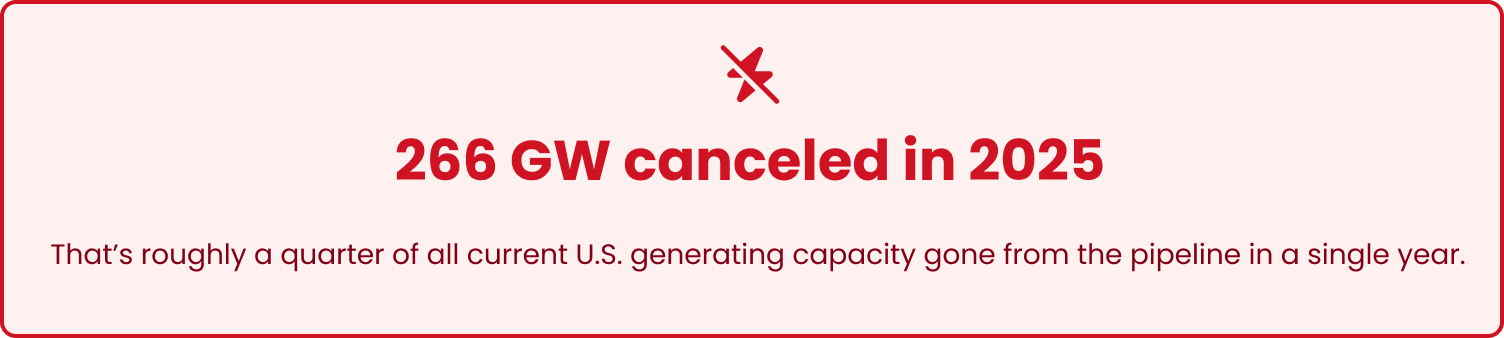
1,891 power projects totaling 266 gigawatts were canceled in 2025. The clean energy share of those cancellations was 93% (86 GW of utility-scale solar, 79 GW of battery storage, 54 GW of wind.)2
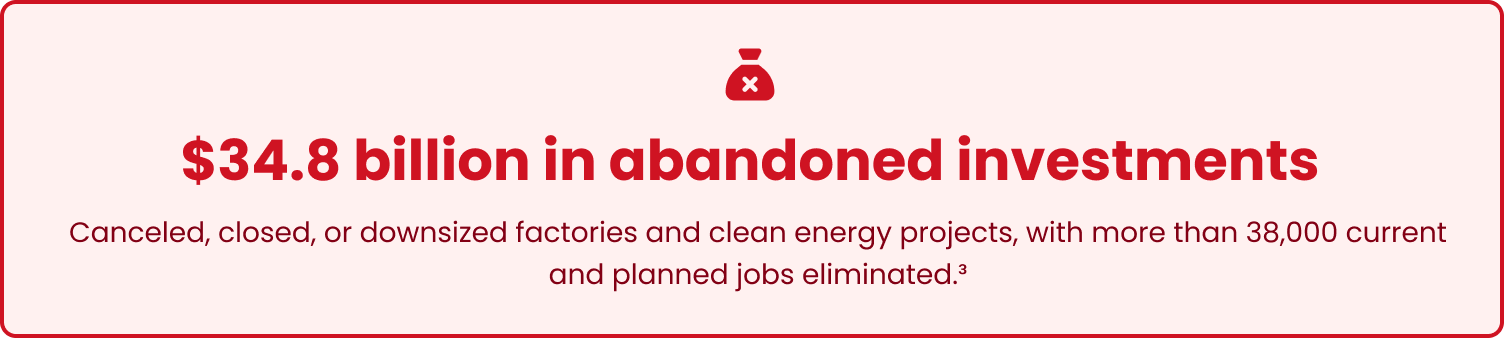
While the OBBBA accelerated the culling of projects, the pipeline is under pressure from multiple directions. Interconnection queue reform under FERC Order 2023 imposed more complexity, stricter requirements, and higher costs driving significant project withdrawals. Grid operators also compounded the pressure. SPP, PJM, and CAISO all paused, delayed, or restructured their interconnection windows in 2025, slowing the path to approval for projects already in queue. High network upgrade costs pushed otherwise viable projects into unworkable economics.4 Offshore wind took its own hit, with 13 GW of reversals in New York, 11 GW in New England, and 2.5 GW in California. The result was a pipeline stressed from multiple directions, not just a single policy change.2
The forward outlook shifted too. The 2025–2030 forecast for U.S. solar, wind, and storage build fell by 23% after OBBBA passed.5 More than 100 GW of proposed wind and solar projects are no longer economically viable under the new tax credit structure.6 The fossil fuel share of planned U.S. power development rose from 9% to 27% since the end of 2022.7 U.S. greenhouse gas emissions rose 1.7% in 2025, with power-sector emissions up 3.6% as coal generation rebounded for the first time in years.8
The demand side of the clean energy market is not slowing down
The U.S. added 53 gigawatts of utility-scale capacity in 2025, the largest single-year total since 2002, as developers rushed to start construction before the credit deadlines.9 Renewables and storage accounted for 90% of new additions.8 The EIA is forecasting a record 86 GW for 2026 ( 51% solar, 28% storage, 14% wind ) driven by the same deadline dynamics.9
Corporate demand for clean energy reached a record too.
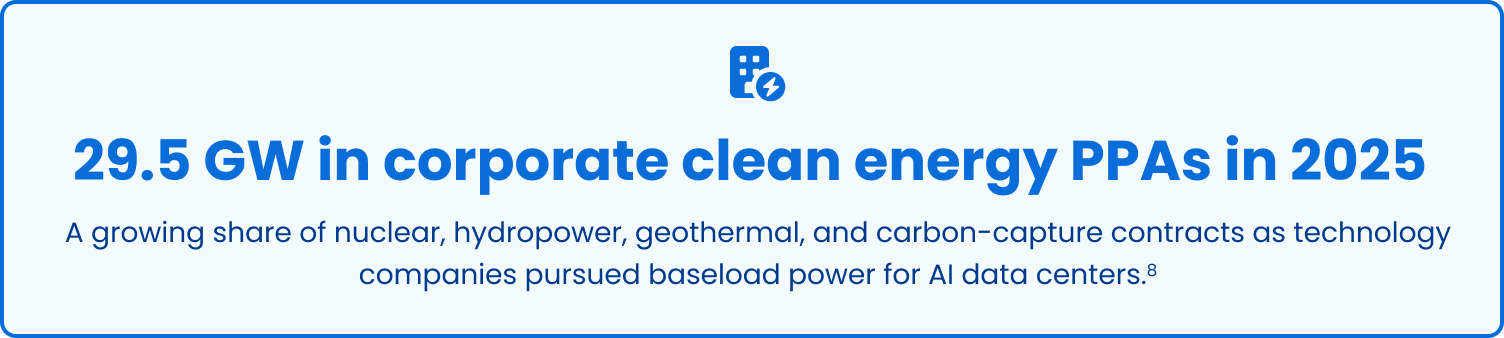
Meta led with more than 10 GW of deals; Amazon followed at 6.8 GW. Energy-transition investment overall reached $378 billion in 2025, up 3.5%, with a 10% rise in grid investment driving the growth.8

About 23 GW of IT load is currently online, with another 48 GW under construction or committed, concentrated in PJM, Texas, and the Southeast. U.S. five-year peak load growth is forecast at 166 GW by 2030, roughly six times the forecast of just three years ago.10
That gap between sustained demand and a contracting pipeline of high-integrity supply is the key thing worth paying attention to.
What this means for corporate clean energy buyers
The pressure on corporate buyers to source clean electricity is increasing as the supply of new, truly additional projects gets harder to bring online.
When companies made RE100 pledges, set SBTi targets, or built clean energy into their CDP disclosures, many of them assumed a market in which new renewable projects were coming online at scale and high-integrity supply was growing.
Scarcity and sustained demand in the same market create real consequences for procurement. Spot RECs, purchased at scale with no additionality behind them, are increasingly difficult to defend to auditors, sustainability frameworks, and stakeholders who understand the difference between buying a generic certificate and enabling new clean energy.
The questions worth bringing to any clean energy procurement conversation right now are specific ones. Is this project additional, would it exist without committed buyer support? Can the provider show additionality, not just a Green-e certificate? Is the supply I am buying tied to a specific project I can name? These questions are more consequential than they were two years ago given the state of the market.
Buyers who can answer those questions confidently are in a stronger position with their boards, their auditors, and their stakeholders than buyers who are holding spot RECs purchased at scale with no impact behind them.
What this means for renewable energy project developers
The financing environment of 2026 created a real and specific problem for project developers: the tax credit economics that underwrote a generation of clean energy projects have been compressed, and the capital structures built around them need to adapt.
For most of the IRA era, favorable tax credit economics did a lot of the heavy lifting in project financing. That cushion is thinner now. What replaces it, in practical terms, is a credible buyer commitment that locks in revenue for the developer.
Long-term contracted REC revenue is one tool that belongs in that conversation. A multi-year REC offtake agreement with a creditworthy corporate buyer does something that tax credits alone never did, it creates a predictable, contracted revenue stream that lenders and equity partners can underwrite independently of the credit environment. In a financing climate where the ITC and PTC are less certain, less accessible, and subject to foreign-sourcing restrictions that add cost and complexity, that kind of revenue visibility matters in ways it didn't two or three years ago.
This is not a replacement for tax equity or project debt. It is an additional contracted offtake opportunity that strengthens a project's financing story at a moment when developers need every credible tool available. A developer who can show committed REC revenue alongside their interconnection agreement and permitting status is presenting a more complete picture of project viability than one who is relying on credit economics alone to carry the underwriting.
It affects how projects are developed from the earliest stages. Offtake has historically been treated as a late-stage element of project development, something to secure once the interconnection queue position, the permitting, and the engineering are in place. In the current environment, that sequencing is a liability. The projects that reach financial close are the ones that treat demand as something that demonstrates viability to lenders and equity partners at the same time it de-risks the project economically.
Projects that underwrote themselves against the old assumptions are being re-evaluated. The projects that get built in this environment will be the ones that assembled the most durable capital structures.
The market is getting more competitive, not collapsing
2025 was a year of records and a year of cancellations, and both things happened at once because the clean energy transition is not a single market moving in a single direction. It is a collection of incentives, timelines, financing structures, and buyer commitments and when the policy environment shifts, those elements have different ripple effects.
What is becoming more clear now is which projects have real demand behind them and which projects were counting on favorable tax credit economics to substitute for it. On the buyer side, the same sorting is happening: which procurement decisions are grounded in additionality and impact, and which are compliance check boxes dressed as sustainability strategy.
Ever.green sources and retires High-Impact RECs from new and repowered U.S. renewable energy projects with additionality and measurable impact.
Sources
- One Big Beautiful Bill Act, Public Law 119-21 — congress.gov
- Cleanview, December 2025 — cleanview.co
- E2 Clean Economy Tracker, 2025 — e2.org
- Lawrence Berkeley National Laboratory, Queued Up 2025 — emp.lbl.gov
- BloombergNEF, July 2025 — bnef.com
- FTI Consulting, July 2025, via pv magazine — pv-magazine-usa.com
- State of Clean Power Q1 2026, EDF / Atlas Public Policy — edf.org
- 2026 Sustainable Energy in America Factbook, BloombergNEF / BCSE — bcse.org
- U.S. Energy Information Administration — eia.gov
- Grid Strategies, 2025 — gridstrategiesllc.com
Researched by Swati Gupta
Get the latest insights on
High-Impact RECs and transferable
tax credits
Related posts



High-Impact RECs
Tax Credits
IRA tools
COMPANy


Aligns with: