Granular REC retirement data and reporting for evolving standards
How Ever.green provides hourly REC data, 15-minute emissions calculations, and multi-registry reporting for defensible renewable energy claims
Jan 22, 2026

Matthew Koppe
Voluntary Renewable Energy Certificate (REC) markets are evolving rapidly. As the Greenhouse Gas Protocol undergoes a major standards update and 100% renewable energy claims face increasing scrutiny, the limitations of existing REC tracking systems have become impossible to ignore. Companies may soon need to juggle multiple tracking systems, many of which operate at quarterly or monthly granularity with minimal metadata and little insight into the emissions impact of additional renewable energy generation.
Companies that want to maintain credible renewable energy claims need infrastructure that can handle reporting complexity.
Ever.green’s updated platform tracks hourly REC generation and calculates tonnes of CO2 avoided for each REC. Our dashboard and improved REC Ledger aggregate this granular impact data for every watt-hour across your entire portfolio.
New, simplified REC reporting across tracking systems
Managing renewable energy procurement will become more complex if standards require granular matching (tighter location and hourly temporal matching.) Instead of supporting one large project for load across the U.S., companies may need to procure RECs for each hour from multiple projects across different grid regions and tracking systems.
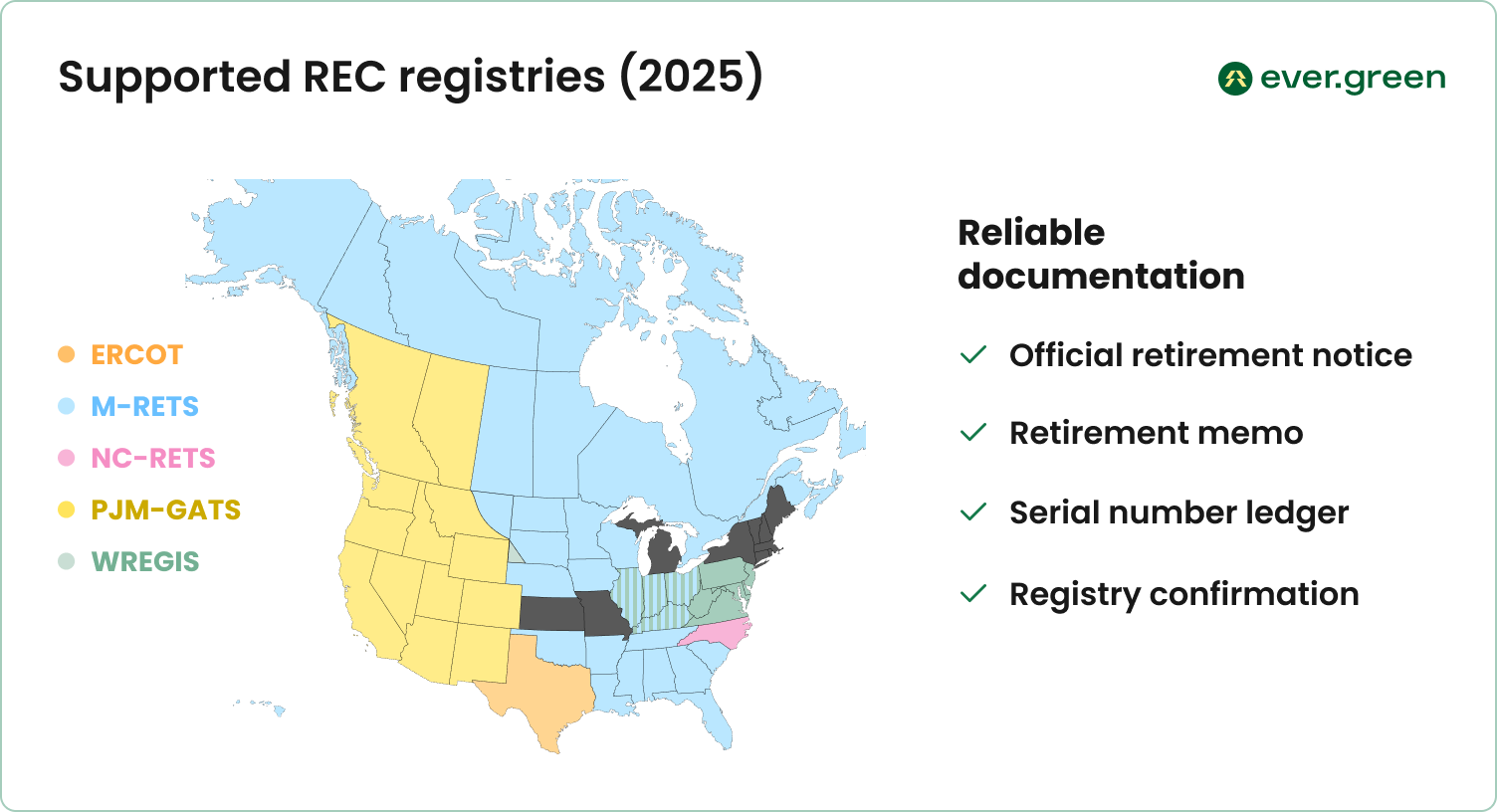
While the primary challenge with granular matching is sourcing projects and contracting RECs for every hour and every location, there are also difficulties in managing data across multiple registries. Doing this manually requires navigating different interfaces, downloading data in different formats, and reconciling timestamps and serial numbers across systems. The Ever.green dashboard handles this complexity and supports ERCOT, WREGIS, PJM GATS, M-RETS, and NC-RETS.
The dashboard provides:
- Quarterly REC retirement totals. Aggregated view of retirements across all projects, showing total MWh retired, avoided emissions, and generation hours in a single interface.
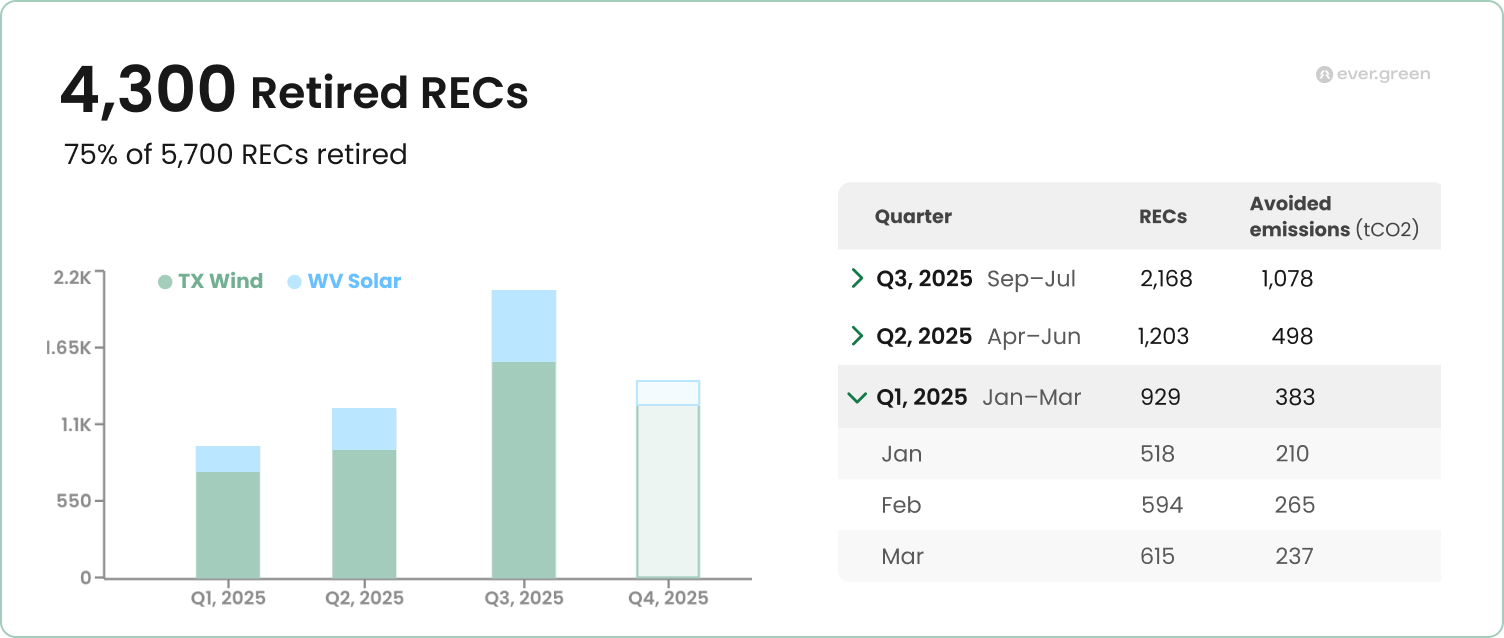
- Projected REC retirements. Based on historical generation patterns and contract terms, the dashboard projects expected retirements for the coming year. This enables planning for upcoming reporting periods.
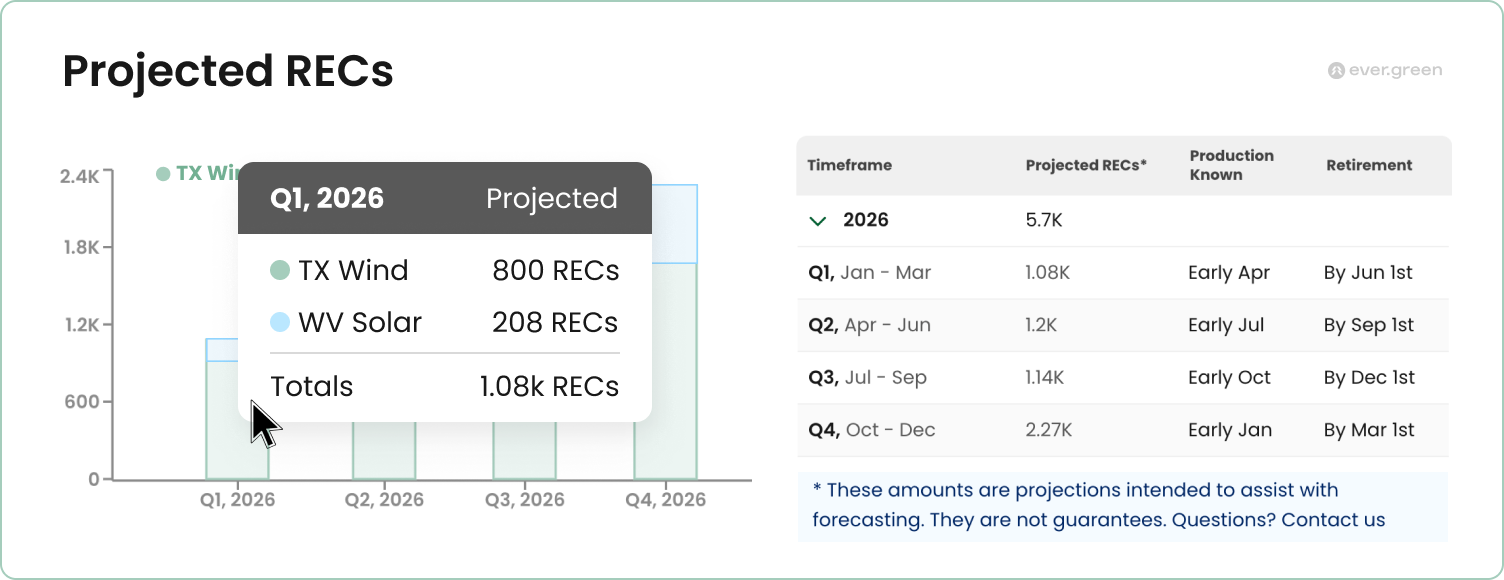
- Avoided emissions analysis. For each retirement, we calculate avoided emissions using WattTime’s marginal emissions data. The dashboard shows both individual REC impact and aggregated emissions avoidance across your entire portfolio.
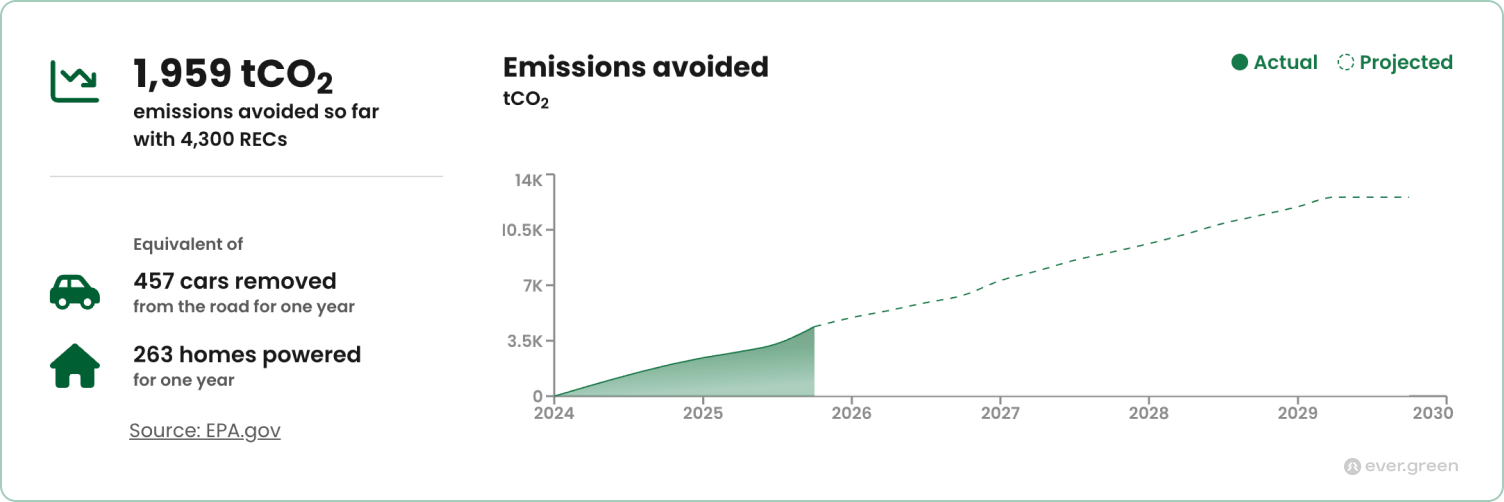
- All documents in one place. Every retirement notice, serial number ledger, and proof of retirement is stored and linked to the corresponding retirement in the dashboard. This creates a complete audit trail accessible to anyone on your team, eliminating the need to track down documents across email threads or multiple registries.
For each retirement in any registry, we provide:
- REC retirement confirmation from the tracking system showing proof of retirement and the official serial number range for the RECs permanently retired on each company’s behalf. This is the primary record that these RECs cannot be claimed by anyone else.
- Serialized REC ledger links the serial number for each watt-hour (Wh) to its location, date, hour, avoided emissions, and the company it was retired on behalf of. This connects each REC to the specific metadata Ever.green provides with the official tracking system record.
How we achieve this level of detail
The reporting capabilities above are possible because of how we track and allocate RECs. Most REC tracking systems provide quarterly summaries with limited or no metadata. Ever.green takes a different approach.
We collect generation data at 15-minute intervals and calculate avoided emissions using marginal emissions data from our partner WattTime for those same 15-minute periods. This granular record of every Wh generated allows us to estimate avoided emissions more accurately and distribute RECs more fairly across companies supporting the same project.
Even more granularity in REC retirement data
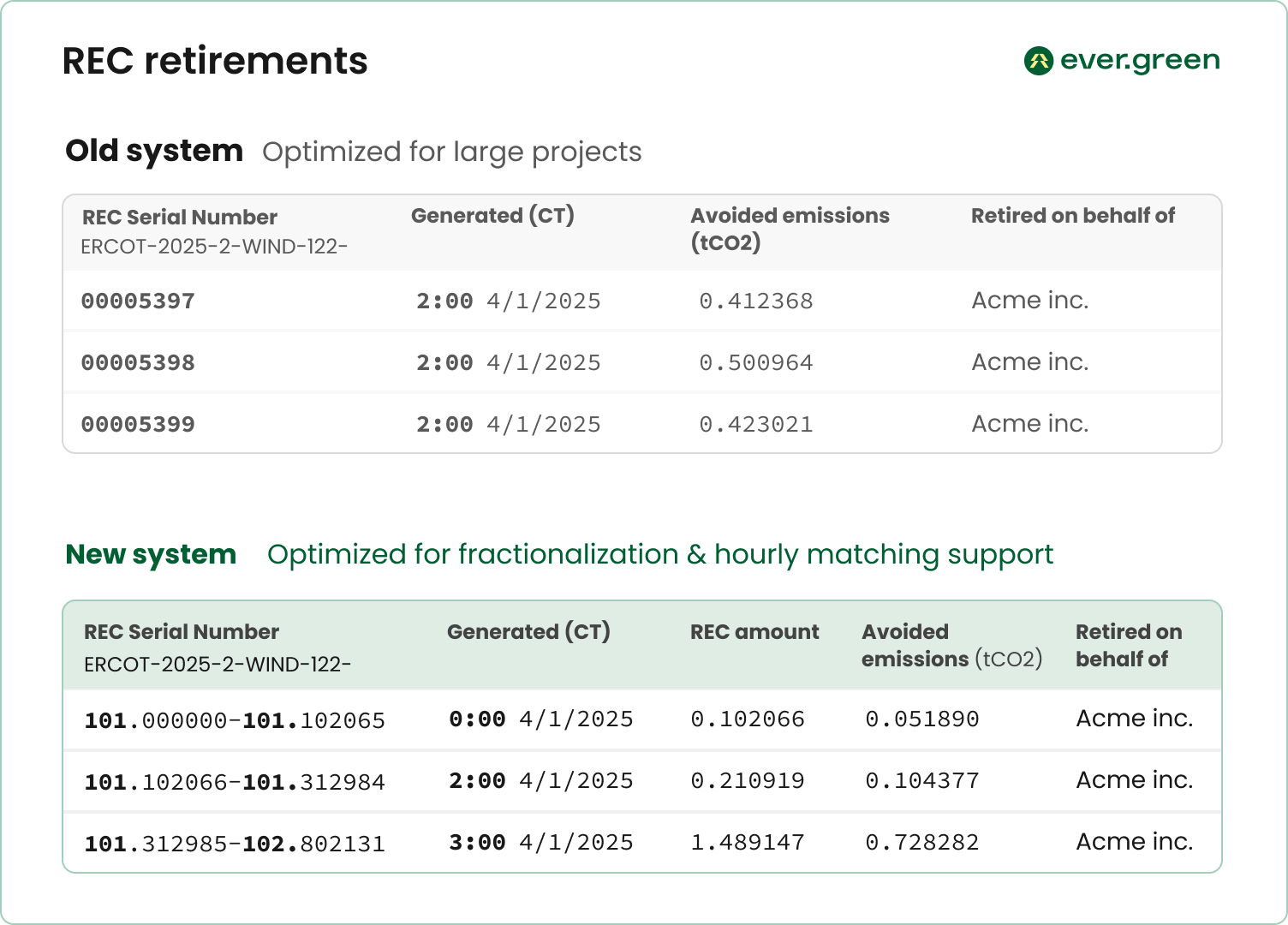
Our previous system assigned each REC to an hour of generation even if the MWh it represented spanned multiple hours (detailed here). For larger projects, this approach worked reasonably well. For smaller projects where generation often fell below 1 MWh per hour, it created inaccuracies in timestamping and avoided emissions calculations.
How the old system worked:
- RECs rounded to whole units. We allocated whole RECs (= 1 MWh) to a single hour, rolling any fractional remainder into the next hour(s).
- Hourly averaging for avoided emissions. To calculate avoided emissions of a REC, we used the average marginal emissions rate from the hour the REC was generated, provided by our partner WattTime. If the marginal emissions rate changed dramatically over the hour, this could lead to inaccuracies. This was particularly common during sunset in areas with large amounts of solar.
- Sequential REC allocation. If multiple companies supported a project, the RECs were allocated to them in a round-robin fashion. This meant the average avoided emissions per REC differed slightly for companies on the same project.
These limitations, while minor, mattered because getting the details right affects credibility. When standards tighten and auditors ask for documentation, the difference between accurate hourly attribution and approximation becomes material.
How the new system works:
- Fractional REC precision. We now allocate RECs to companies in units of 1 Wh. There are 1,000,000 Wh in every REC. Fractional RECs are now always attributed to the hour they were actually generated.
- 15-minute avoided emissions intervals. We attribute the energy generated in each 15-minute interval to the marginal emissions rate for that interval. This leads to higher accuracy during times when the marginal emissions rate changes during an hour.
- Proportional REC allocation. We now allocate a percentage of every REC generated within an hour to every supporting company. This means the average avoided emissions will be the same for every company that supported the project.
The result is a level of precision that aligns with how accounting and reporting standards are evolving.
Connecting the dots across registries
To make verification possible across multiple tracking systems, we needed a consistent approach to documentation that works regardless of which registry holds the RECs. Each registry provides different levels of detail in their official records. Some, like ERCOT, allow detailed memos. Others provide only basic retirement confirmations. Our solution was to create a parallel layer of documentation that maintains the same level of detail across all registries while remaining verifiable through each registry's official records.
This means you can verify your renewable energy claims with auditors across any registry without navigating different tracking systems, documentation standards, or verification processes.
What makes this defensible
The companies we work with often tell us that one big concern is whether the RECs they buy today will still meet standards three years from now. When you make a long-term commitment to a renewable energy project, you need confidence that the documentation supporting your claims will hold up as frameworks evolve.
The platform we built is designed for this reality. Hourly granularity and detailed metadata provide the level of detail needed for potential granular matching requirements or 24/7 clean energy goals. The ability to retire RECs across multiple registries enables the geographic distribution that emerging standards may demand. Comprehensive documentation of every REC serial number, generation hour, avoided emissions calculation, and registry confirmation creates an audit trail that can withstand scrutiny.
Ever.green is building systems flexible enough to adapt as standards take shape, while maintaining the rigor that makes renewable energy claims defensible today. We test every REC contract for additionality to ensure your procurement actually brings new renewable energy to the grid and evaluate environmental and community impact to show the real-world consequences of your investment. This is the consequential impact customers seek and the world needs, even if standards don't require it.
What’s next
Ever.green continues to make High-impact RECs more accessible and more transparent. Our immediate focus is expanding registry coverage to handle retirements in additional tracking systems across the US and Canada. We are working to update our systems to handle the increasing complexity from potential new Scope 2 accounting standards, as well as widening the range of projects we support.
Sustainability teams should be able to focus on making decisions that create meaningful emissions reductions. Ever.green handles the complexity by finding great projects, testing for impact and additionality and providing the infrastructure so you can focus on making an impact.
Get the latest insights on
High-Impact RECs and transferable
tax credits
Related posts




High-Impact RECs
Tax Credits
IRA tools
COMPANy


Aligns with: